

Can you confidently deploy your microservices without worrying that a tiny change will break your entire system?
If you’ve ever felt a twinge of anxiety before hitting that deploy button—especially when your services are talking to each other through APIs—consumer driven contract testing with Pact might just be the safety net you need. In this guide, we’ll break down what consumer-driven contract testing is, why Pact is a game-changer for microservices, and how you can start using it to build more reliable, collaborative systems. No more crossing your fingers and hoping for the best!
Why Contract Testing Matters in Microservices
Let’s set the scene: you’re working on a microservices architecture. Your team owns the Order Service, but it depends on the Inventory Service to check stock before confirming an order. The Inventory Service is managed by another team, and their API changes from time to time. One day, they update a field name in their response. Suddenly, your Order Service starts throwing errors in production. Ouch.
This is the classic microservices headache: integration drift. Each service evolves independently, and even small changes can cause big problems for consumers. Traditional integration tests are slow, brittle, and often require full environments to run. Unit tests don’t catch these cross-service issues. So how do you ensure your services can talk to each other without breaking the whole system?
That’s where consumer-driven contract testing comes in. It’s like a handshake agreement between services, written down and automatically checked, so everyone knows what to expect.
What is Consumer-Driven Contract Testing?
Imagine you’re ordering coffee at a drive-thru. You expect the barista to understand your order and hand you the right drink. If they suddenly start using a new menu or change the cup sizes, you’d be confused (and probably caffeine-deprived).
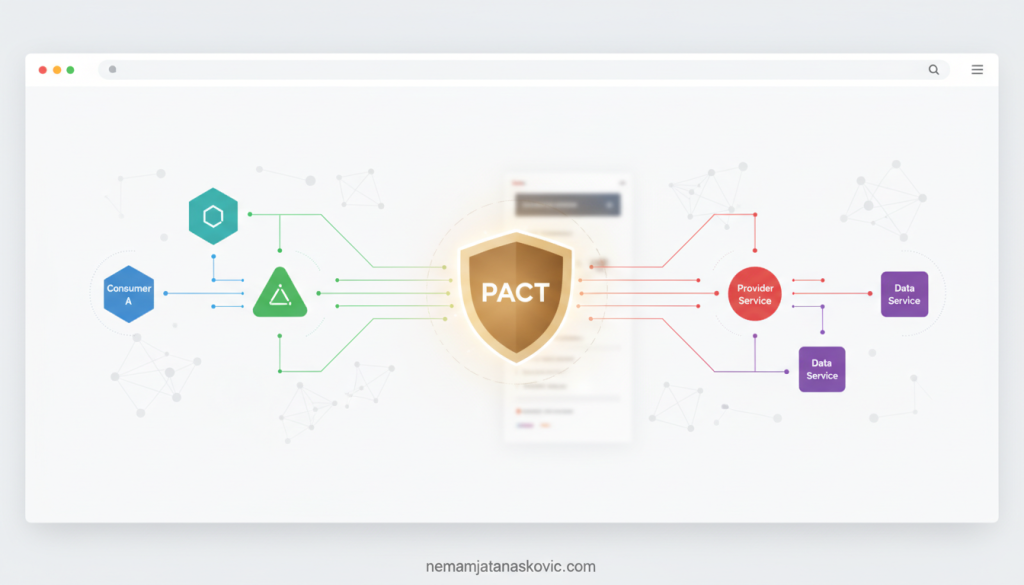
Consumer-driven contract testing formalizes this agreement between the consumer (the service making the request) and the provider (the service responding). The consumer defines its expectations in a contract. The provider then verifies it can meet those expectations. If either side changes, the contract test will catch the mismatch before it hits production.
Key points:
– The contract is written from the consumer’s perspective.
– Providers must honor all contracts from their consumers.
– Tests are automated and can run in CI/CD pipelines.
This approach flips the traditional testing pyramid on its head. Instead of relying on slow, flaky end-to-end tests, you get fast, focused feedback on what really matters: the API interactions your consumers actually use.
Meet Pact: The Friendly Contract Testing Tool
So, how do you actually implement consumer-driven contract testing? Enter Pact, an open-source tool designed specifically for this purpose. Pact lets you write contracts as code, share them between teams, and automatically verify that both sides are playing by the rules.
Pact supports a wide range of languages (Java, Python, JavaScript, .NET, and more), making it a great fit for polyglot microservices environments. It’s lightweight, easy to integrate, and comes with a handy Pact Broker for sharing contracts across teams.
How Pact works in a nutshell:
1. The consumer writes a test describing the expected API interaction (the contract).
2. Pact generates a contract file (a “pact”).
3. The provider runs verification tests against the pact to ensure it can fulfill the contract.
4. If the provider changes its API in a way that breaks the contract, the test fails—before you deploy.
The Pact Workflow: Step by Step
Let’s walk through a typical Pact workflow using a concrete example. Suppose you have two services:
– Consumer: Order Service (places orders, checks inventory)
– Provider: Inventory Service (returns stock levels)
1. Writing the Consumer Test
The Order Service team writes a test describing how it expects to interact with the Inventory Service. For example, it might expect a GET /inventory/sku123 endpoint to return a JSON response with a quantity field.
// Example using Pact JVM (Java)
@Pact(consumer = "OrderService", provider = "InventoryService")
public RequestResponsePact inventoryAvailable(PactDslWithProvider builder) {
    return builder
        .given("SKU 123 exists and is in stock")
        .uponReceiving("A request for inventory of SKU 123")
            .path("/inventory/sku123")
            .method("GET")
        .willRespondWith()
            .status(200)
            .body("{"quantity": 10}")
        .toPact();
}
This test runs locally, using a mock server provided by Pact. If the Order Service code can talk to the mock and get the expected response, the test passes. Pact then generates a contract file (usually JSON) describing this interaction.
2. Publishing the Contract
The contract file is published to a Pact Broker—a central place where all your service contracts live. This makes it easy for provider teams to discover what their consumers expect.
3. Provider Verification
Now it’s the Inventory Service team’s turn. They pull the contract from the Pact Broker and run verification tests against their real API implementation. Pact checks that the provider’s API matches the contract. If the provider changes the response format or removes a field, the test fails.
4. Continuous Integration and Feedback
Both consumer and provider teams can run these tests in their CI/CD pipelines. If a contract is broken, the build fails, and the responsible team gets immediate feedback. No more surprises in production!
Why Use Consumer-Driven Contract Testing with Pact?
You might be wondering: why go through all this effort? Here’s what makes consumer driven contract testing with Pact so valuable in real-world microservices:
1. Early Detection of Breaking Changes
Pact catches contract violations before they reach production. If a provider changes its API in a way that breaks a consumer, the test fails in CI. This means fewer late-night incidents and less finger-pointing between teams.
2. Decoupled Development
With Pact, consumers and providers can develop independently. Consumers can mock provider APIs using Pact’s mock server, unblocking their work even if the provider isn’t ready yet. Providers can see exactly what their consumers expect, reducing guesswork.
3. Living Documentation
Contracts generated by Pact serve as up-to-date, executable documentation. No more outdated API docs or confusion about what’s supported. The contract is the source of truth.
4. Confidence in Refactoring
Want to refactor your API? Pact gives you the confidence to make changes, knowing you’ll be alerted if you break a consumer. This encourages healthy evolution of your services.
5. Faster, More Reliable Deployments
Because contract tests are fast and focused, you can run them on every commit. This leads to quicker feedback cycles and safer, more frequent releases.
How Pact Differs from Traditional Integration Testing
Let’s clear up a common misconception: Pact is not a replacement for all integration tests. Instead, it complements them by focusing on the contract—the API interactions that matter most.
Traditional integration tests often require spinning up full environments, databases, and all dependent services. They’re slow, flaky, and hard to maintain. Pact, on the other hand, lets you test API contracts in isolation, using mocks and stubs. This makes your tests faster, more reliable, and easier to debug.
Key differences:
– Scope: Pact tests focus on API contracts, not end-to-end flows.
– Speed: Pact tests run quickly, without needing full environments.
– Feedback: Pact gives immediate, actionable feedback on contract changes.
You’ll still want some end-to-end tests for critical user journeys, but Pact helps you catch most integration issues early and efficiently.
Setting Up Pact: A Practical Example in Java
Let’s get our hands dirty with a step-by-step example using Java and Spring Boot. (If you’re new to Spring Boot, check out this friendly guide for a quick primer.)
1. Add Pact Dependencies
First, add the necessary dependencies to your pom.xml:
<dependency>
    <groupId>au.com.dius.pact.consumer</groupId>
    <artifactId>junit5</artifactId>
    <version>4.3.6</version>
    <scope>test</scope>
</dependency>
<dependency>
    <groupId>au.com.dius.pact.provider</groupId>
    <artifactId>junit5</artifactId>
    <version>4.3.6</version>
    <scope>test</scope>
</dependency>
2. Write a Consumer Pact Test
Let’s say our Order Service needs to check inventory:
@ExtendWith(PactConsumerTestExt.class)
public class InventoryClientPactTest {
    @Pact(consumer = "OrderService", provider = "InventoryService")
    public RequestResponsePact inventoryAvailable(PactDslWithProvider builder) {
        return builder
            .given("SKU 123 exists and is in stock")
            .uponReceiving("A request for inventory of SKU 123")
                .path("/inventory/sku123")
                .method("GET")
            .willRespondWith()
                .status(200)
                .body("{"quantity": 10}")
            .toPact();
    }

    @Test
    @PactTestFor(pactMethod = "inventoryAvailable")
    void testInventoryClient(MockServer mockServer) {
        InventoryClient client = new InventoryClient(mockServer.getUrl());
        int quantity = client.getQuantity("sku123");
        assertEquals(10, quantity);
    }
}
This test spins up a mock server, simulates the provider, and checks that the consumer code works as expected.
3. Publish the Pact File
After running the test, Pact generates a contract file (e.g., OrderService-InventoryService.json). You can publish this to a Pact Broker using the Pact CLI or a CI/CD step.
4. Provider Verification
On the provider side, you’ll write a test that loads the contract and verifies the real API implementation:
@Provider("InventoryService")
@PactBroker(host = "pact-broker.example.com", scheme = "https")
public class InventoryProviderPactTest {
    @TestTemplate
    @ExtendWith(PactVerificationInvocationContextProvider.class)
    void pactVerificationTestTemplate(PactVerificationContext context) {
        context.verifyInteraction();
    }
}
Pact will call your real API endpoints and check that the responses match the contract. If there’s a mismatch, the test fails.
Pact Broker: The Contract Hub
The Pact Broker is the heart of contract sharing in Pact. It acts as a central repository for all your contracts, making it easy for teams to discover, publish, and verify contracts.
Key features:
– Stores contracts and verification results
– Supports versioning and tagging (e.g., prod, staging)
– Visualizes relationships between consumers and providers
– Enables automated workflows (e.g., can-I-deploy checks)
You can run the Pact Broker as a Docker container or use a managed service. Integrating it into your CI/CD pipeline ensures contracts are always up to date and verified before deployment.
Real-World Example: E-Commerce Microservices
Let’s bring it all together with a real-world scenario. Imagine an e-commerce platform with these services:
– Product Service (manages product catalog)
– Inventory Service (tracks stock levels)
– Order Service (handles orders)
– Payment Service (processes payments)
Each service has its own team and release cycle. The Order Service depends on both the Inventory Service and the Payment Service. Here’s how consumer-driven contract testing with Pact helps:
- The
Order Serviceteam writes contracts for the APIs it consumes (InventoryandPayment). - These contracts are published to the Pact Broker.
- The
InventoryandPaymentteams pull the contracts and verify their APIs against them. - If a provider wants to change its API, it can see which consumers will be affected and coordinate changes safely.
- All teams get fast feedback in CI/CD, reducing integration bugs and deployment delays.
This approach fosters collaboration, trust, and agility—no more waiting for full integration environments or last-minute surprises.
Best Practices for Consumer-Driven Contract Testing with Pact
Ready to get the most out of Pact? Here are some tips from the trenches:
1. Keep Contracts Focused and Realistic
Write contracts that reflect real consumer needs, not hypothetical scenarios. Avoid over-specifying (e.g., requiring exact field order in JSON) unless it truly matters.
2. Automate Everything
Integrate Pact tests and contract publishing into your CI/CD pipelines. Use the Pact Broker’s can-I-deploy feature to block deployments if contracts aren’t verified.
3. Communicate Across Teams
Consumer-driven contract testing is a team sport. Make sure consumer and provider teams talk regularly, especially when planning breaking changes.
4. Version and Tag Contracts
Use semantic versioning and tags (e.g., prod, staging) in the Pact Broker to manage contract lifecycles. This helps coordinate releases and rollbacks.
5. Clean Up Old Contracts
Regularly prune unused or outdated contracts from the Pact Broker. This keeps your contract landscape tidy and relevant.
6. Use Provider States Wisely
Provider states in Pact let you set up the provider in a specific state before verifying an interaction (e.g., “SKU 123 exists and is in stock”). Use them to make your tests deterministic and meaningful.
7. Don’t Over-Rely on Pact Alone
Pact is powerful, but it’s not a silver bullet. Combine it with other testing strategies (unit, integration, end-to-end) for comprehensive coverage.
Common Pitfalls and How to Avoid Them
Even with the best intentions, it’s easy to stumble. Here are some common mistakes and how to sidestep them:
- Over-Specifying Contracts: Don’t require exact JSON formatting or field order unless necessary. Focus on what matters to the consumer.
- Ignoring Provider Verification: Always verify contracts against the real provider implementation, not just mocks.
- Letting Contracts Get Stale: Automate contract publishing and verification to keep everything up to date.
- Lack of Team Communication: Use contracts as a conversation starter, not a replacement for collaboration.
- Testing Too Much or Too Little: Strike a balance—test the interactions that matter, not every possible edge case.
Advanced Topics: Pact in Polyglot Environments
Modern microservices often use multiple languages. The good news? Pact supports Java, Python, JavaScript, .NET, Ruby, and more. You can write consumer tests in one language and provider verifications in another. The contract file (JSON) is the common language.
Example:
– Consumer: JavaScript (Node.js)
– Provider: Java (Spring Boot)
– Pact Broker: Shares contracts between teams
This flexibility makes Pact a great fit for diverse teams and tech stacks.
Integrating Pact with CI/CD Pipelines
To get the most value from consumer driven contract testing with Pact, integrate it into your CI/CD pipeline. Here’s a typical flow:
- Consumer Build: Run Pact consumer tests, generate contract, publish to Pact Broker.
- Provider Build: Pull latest contracts from Pact Broker, run provider verification tests.
- Deployment Gate: Use Pact Broker’s can-I-deploy feature to block deployments if contracts aren’t verified.
This ensures that only compatible versions of consumers and providers are deployed together, reducing integration risks.
Frequently Asked Questions (FAQ)
What’s the difference between consumer-driven contract testing and traditional contract testing?
Traditional contract testing often involves the provider defining the contract (e.g., via OpenAPI/Swagger). In consumer-driven contract testing, the consumer defines the contract, ensuring their needs are met. Pact is designed for the consumer-driven approach.
Can Pact be used for asynchronous APIs (e.g., messaging, events)?
Yes! Pact supports asynchronous interactions (e.g., Kafka, RabbitMQ) via Pact’s message support. You can define contracts for event-driven architectures, not just HTTP APIs.
How does Pact compare to other contract testing tools?
Pact is one of the most popular tools for consumer-driven contract testing, with broad language support and a strong community. Alternatives include Spring Cloud Contract (Java), Hoverfly, and Dredd. Choose the tool that best fits your stack and workflow.
Is Pact suitable for large organizations?
Absolutely. Many large companies use Pact to manage hundreds of microservices. The Pact Broker scales well and supports complex workflows, including versioning, tagging, and deployment gates.
Can I use Pact with legacy systems?
Yes, though it may require some extra setup. You can write provider verification tests against legacy APIs, even if they weren’t originally designed for contract testing.
Wrapping Up: Why Now is the Time for Consumer-Driven Contract Testing with Pact
Microservices are here to stay, and with them comes the challenge of keeping independent teams and services in sync. Consumer driven contract testing with Pact offers a practical, proven way to catch integration issues early, foster collaboration, and ship with confidence.
By adopting Pact, you’re not just adding another tool to your stack—you’re building a culture of shared responsibility and trust between teams. You’ll spend less time debugging integration bugs and more time delivering value to your users.
Ready to give it a try? Start small: pick one consumer-provider pair, write your first contract, and see how it transforms your workflow. The peace of mind is worth it.
If you’re looking to deepen your Java skills or explore more design patterns for robust microservices, check out this deep dive into the Strategy Pattern. And remember: every great system starts with clear communication—Pact just makes it automatic.
Happy testing, and may your contracts always be green!